
PRODUCT DESIGN | B2C Mobile
Frich Saving Challenge
Rethinking motivation beyond monetary rewards. By shifting focus from rewards to behavioral reinforcement, we successfully improved re-engagement and user retention.
MY ROLE
Product Strategy
User Testing & Iteration
UX Enhancement
TEAM MEMBERS
1 Product Manager
1 Developer
1 Growth Manager
1 Product Designer (Me)
TIMELINE
March 2022 - May 2022
CATEGORIES
B2C
Native Mobile
Introduction
Frich’s Saving Challenge: beta launch with low engagement and high drop-off
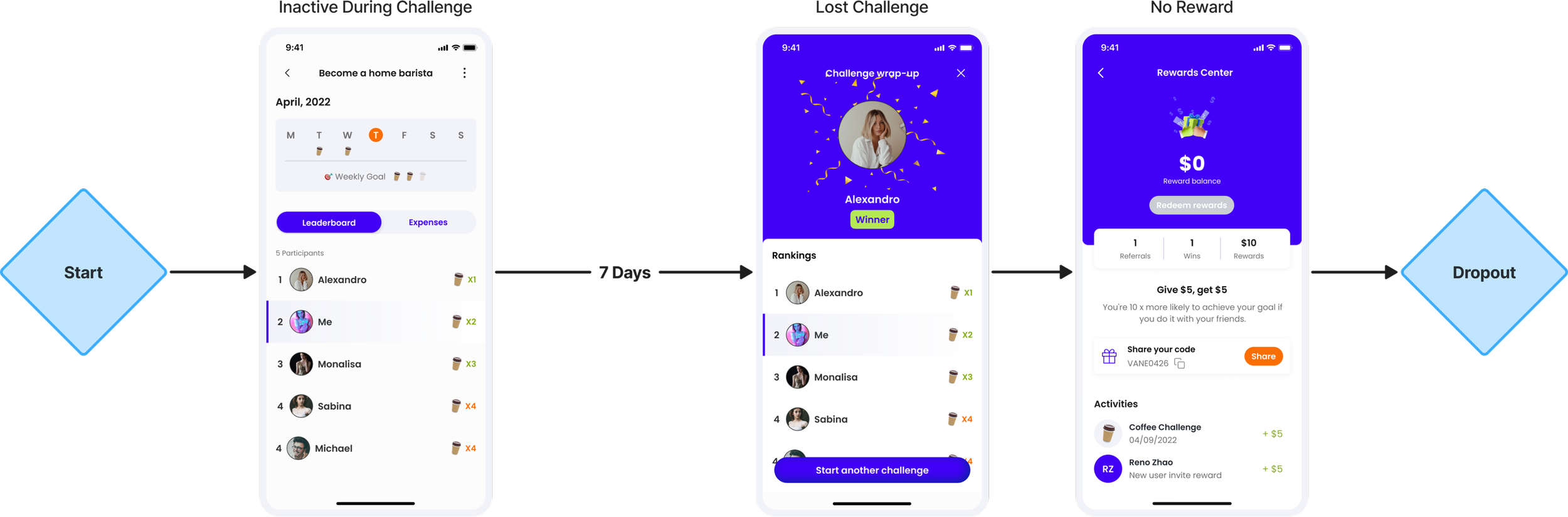
In Q1 2022, Frich launched the Saving Challenge, a gamified savings feature designed to increase DAU through cash rewards. However, initial data revealed disappointing results—high user drop-off rates, low challenge re-engagement, and stagnant daily active users.
Design Objective
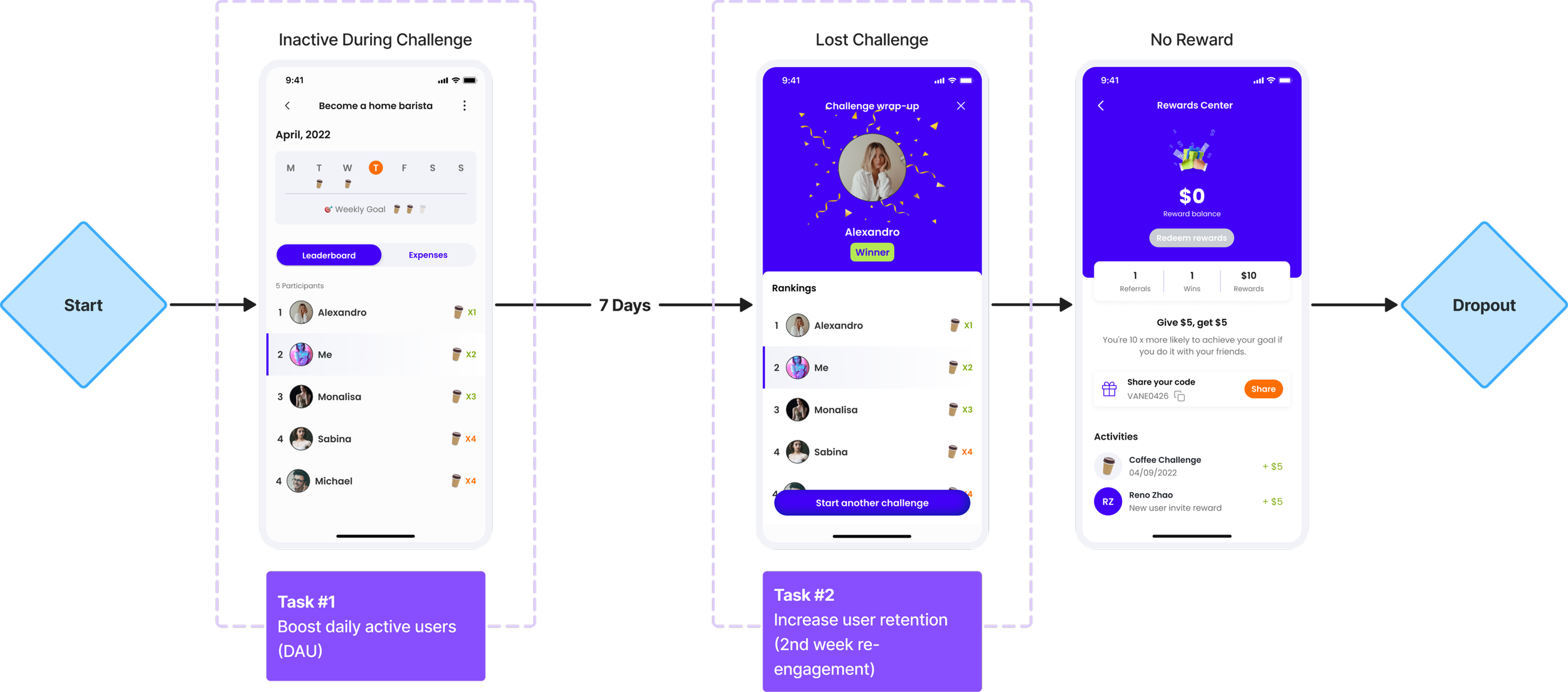
Implementing design improvements to enhance user motivation, ultimately driving engagement and retention.
My role was to optimize the Saving Challenge experience by implementing strategic design improvements that enhance user motivation and encourage sustained participation. By addressing key friction points and refining the gamification elements, my goal was to create a more engaging and rewarding experience that not only attracts users but also keeps them actively involved.
End Goal
Keep users actively involved and reduce user dropouts.
Challenge
A typical winner-takes-all problem.
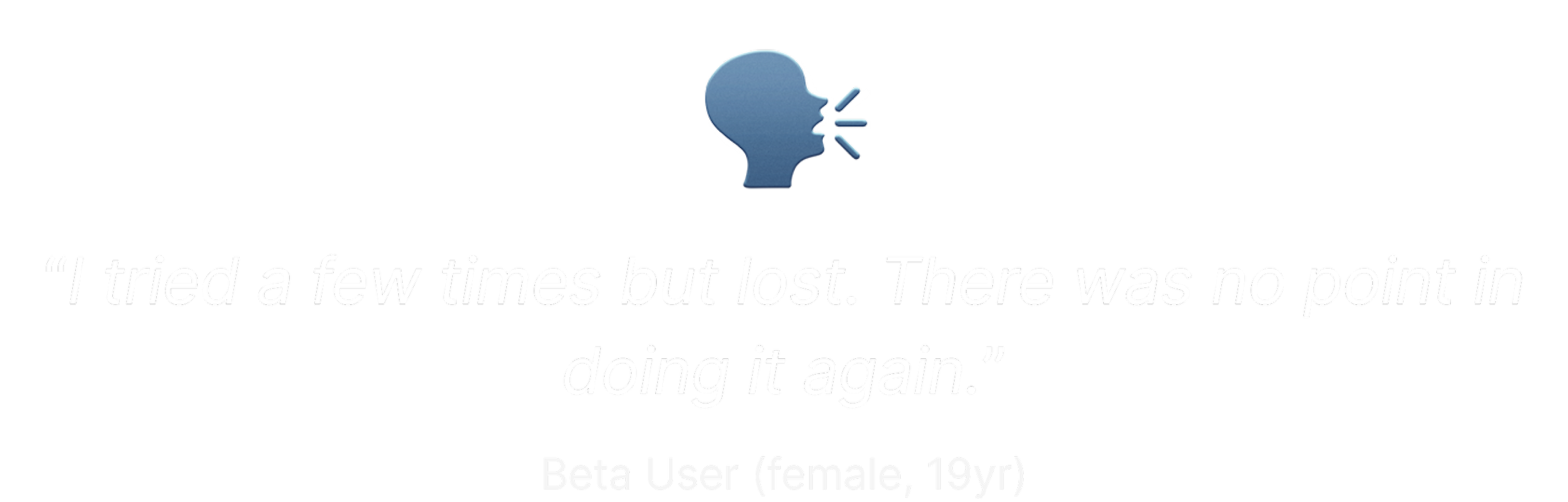
User behavior analysis and feedback revealed a fundamental issue: a “winner-takes-all” dynamic that discouraged engagement. Users who didn’t win felt left out with no rewards, leading to low re-engagement.
Competitive Research
Incremental rewards sounds like a feasible solution to our issue.
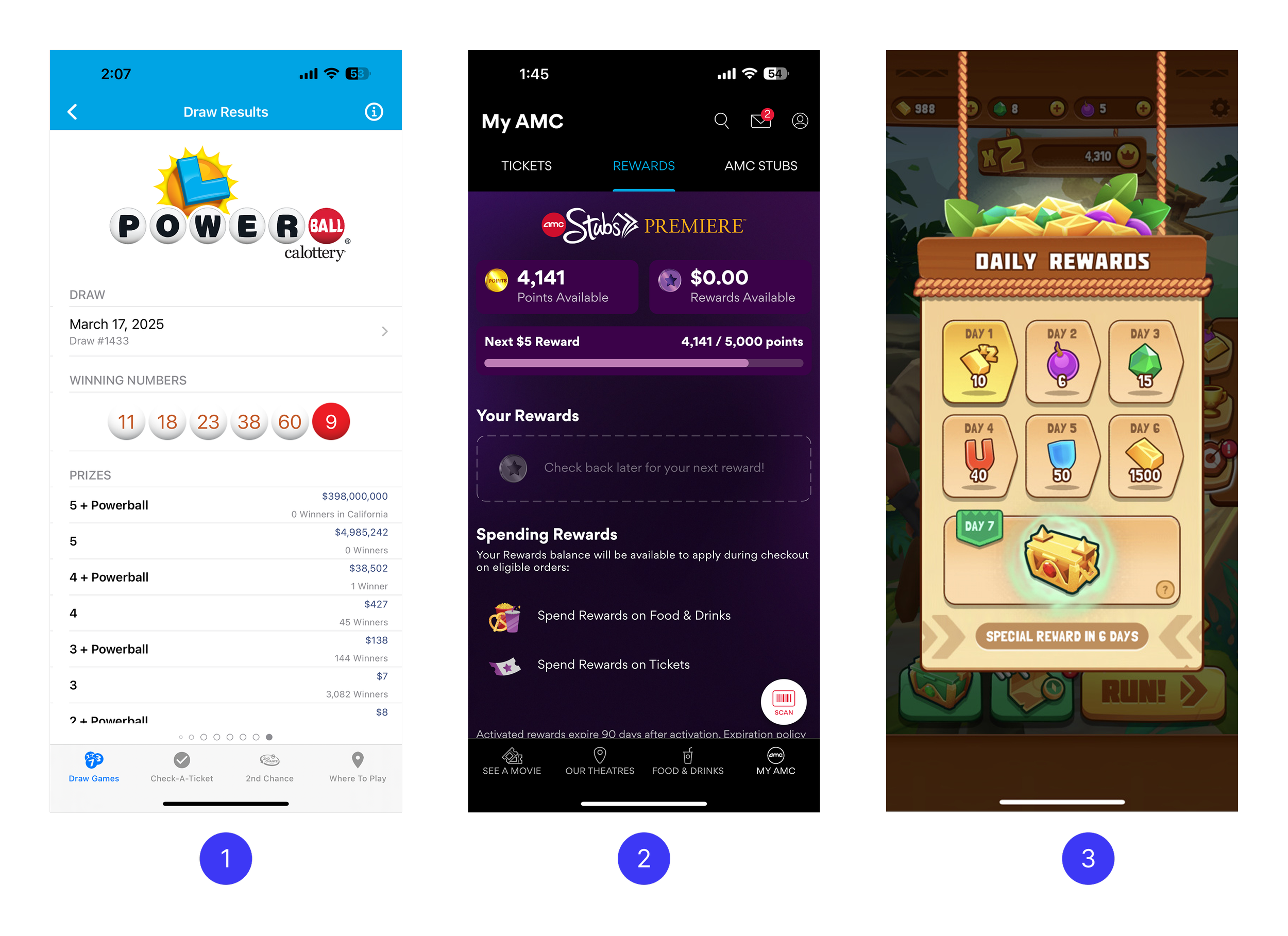
We explored similar gamified financial products to understand what drives user engagement and long-term participation. A common success pattern we identified was incremental rewards—a system where users earn small, progressive incentives as they achieve milestones. This approach keeps users motivated by providing frequent positive reinforcement, making progress feel tangible and rewarding. Unlike one-time or high-bar rewards, incremental rewards help sustain engagement by creating a habit loop, encouraging users to stay active and consistently participate in the challenge.
Inspirations
-
Giving small rewards to non-winners reduces frustration and keeps users motivated for future participation.
-
Accumulating points over time fosters a sense of progress, encouraging long-term engagement and loyalty.
-
Incentivizing consistent actions, like daily check-ins, helps build user habits and sustain engagement.
Ideation
Aligning on and testing a points-based rewards system.
Leveraging insights from market research, I led rapid design ideation to explore and adapt proven success strategies from competitors. Through team discussions, we decided to implement a points-based rewards system and conducted a small-scale test to validate its impact on user engagement.
Change 1
Introduce multi-tiered reward system - everyone is a now a winner!
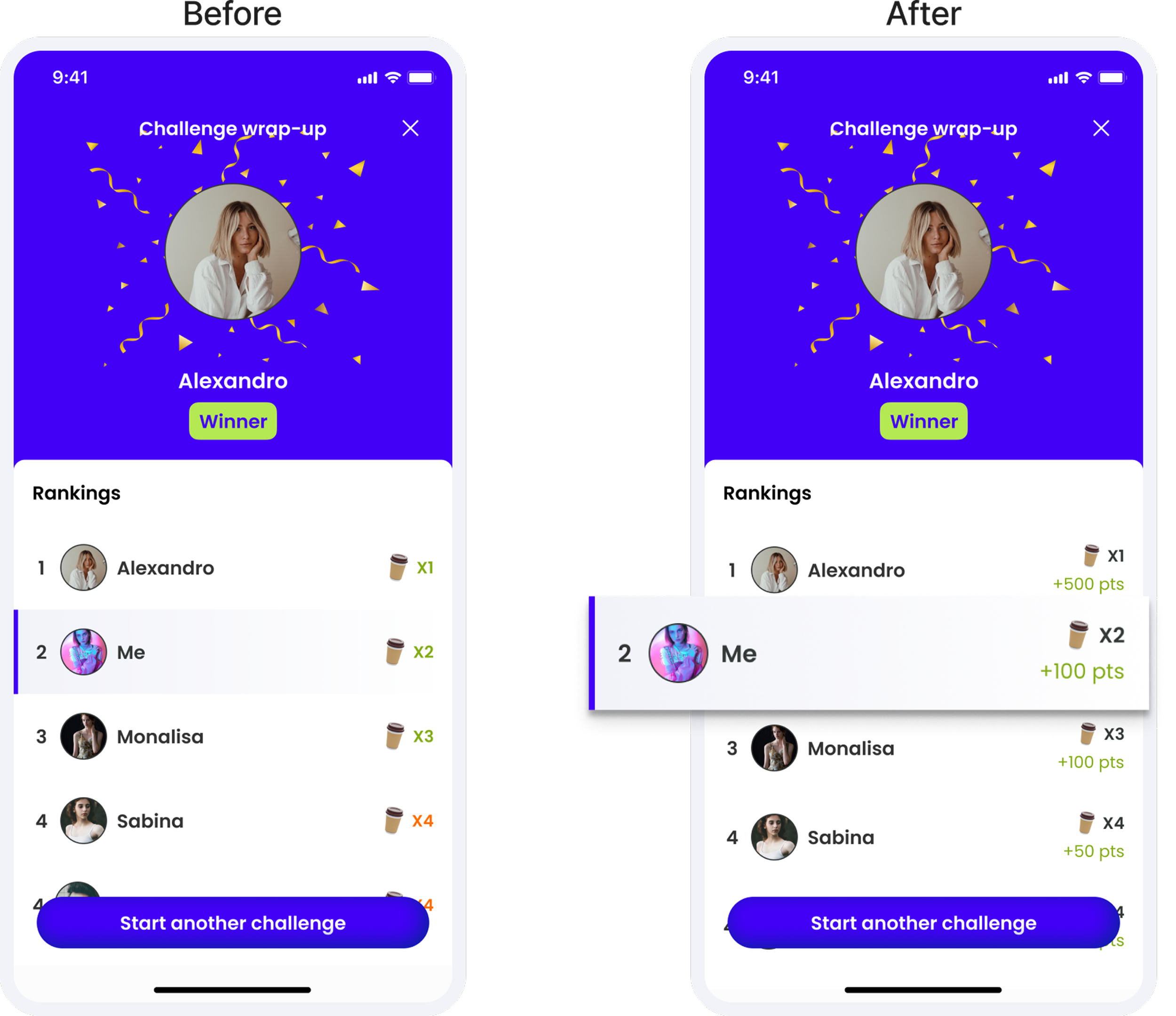
We replaced the all-or-nothing model with tiered rewards to soften losses and keep users motivated. This approach encourages continued participation by offering smaller, incremental rewards, driving re-engagement.
Change 2
Multi-tiered Reward System
By giving everyone points at the end, we ensure that all users feel a sense of achievement, regardless of the outcome. This boosts morale, reduces frustration, and encourages continued participation in future challenges.
Integrate progress-driven incentives to mitigate user fatigue from repeated unsuccessful attempts.
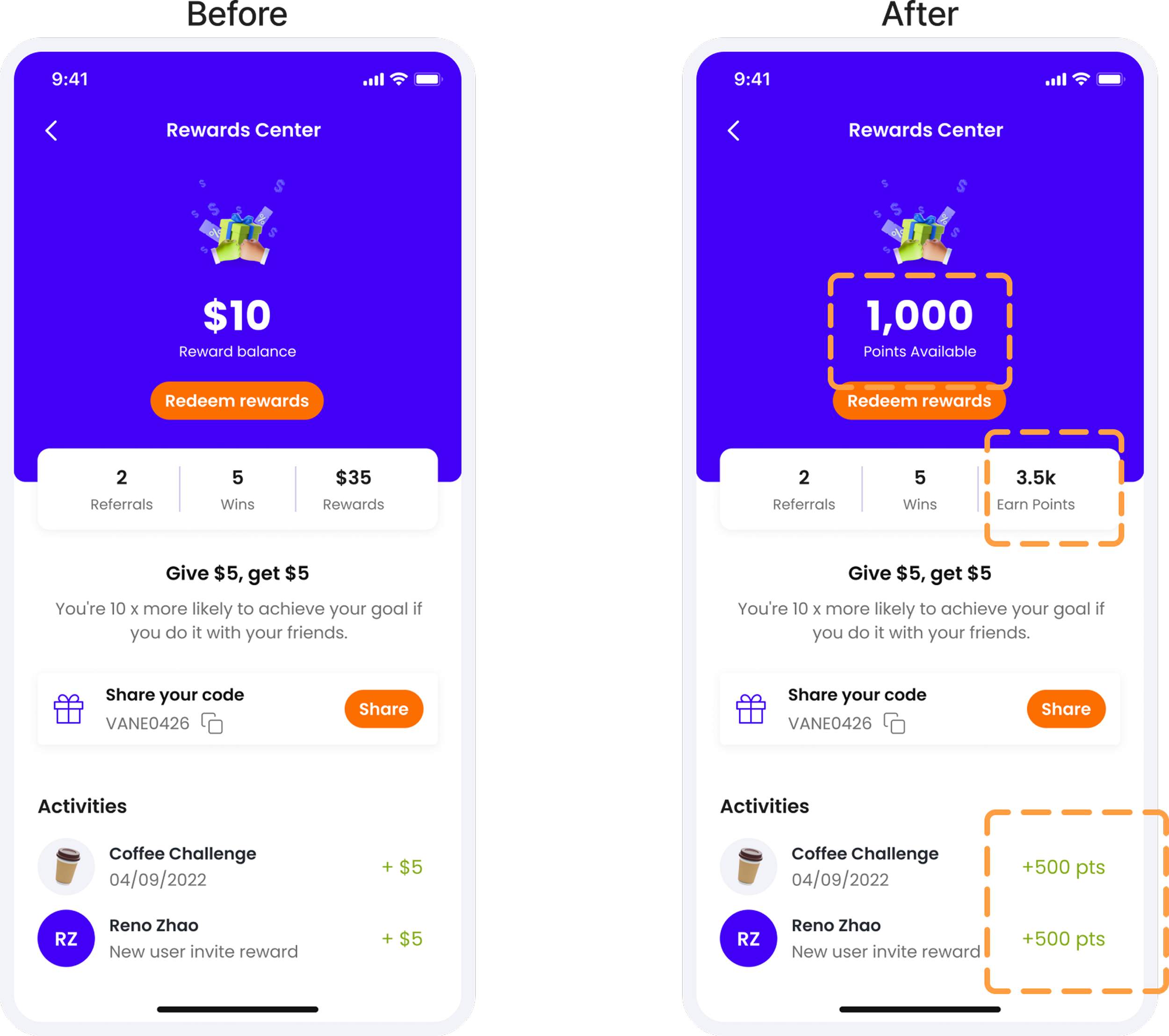
By rewarding incremental progress rather than only final outcomes, users are motivated to keep going, even when they don’t immediately succeed. This approach helps reduce frustration and encourages continued participation, leading to sustained engagement and better retention over time.
Change 3
Progress-Based Incentives
A point-based system allowed users to accumulate points over multiple challenges, redeemable for small rewards.
Leverage daily check-ins to increase user engagement.
We introduced the daily check-in feature to foster consistent user engagement by offering instant rewards for regular participation. This creates a sense of accomplishment and reinforces the habit loop, making the app more engaging and encouraging users to return daily. By providing immediate gratification, we aimed to boost DAU and create a more rewarding experience that drives long-term user retention and involvement.
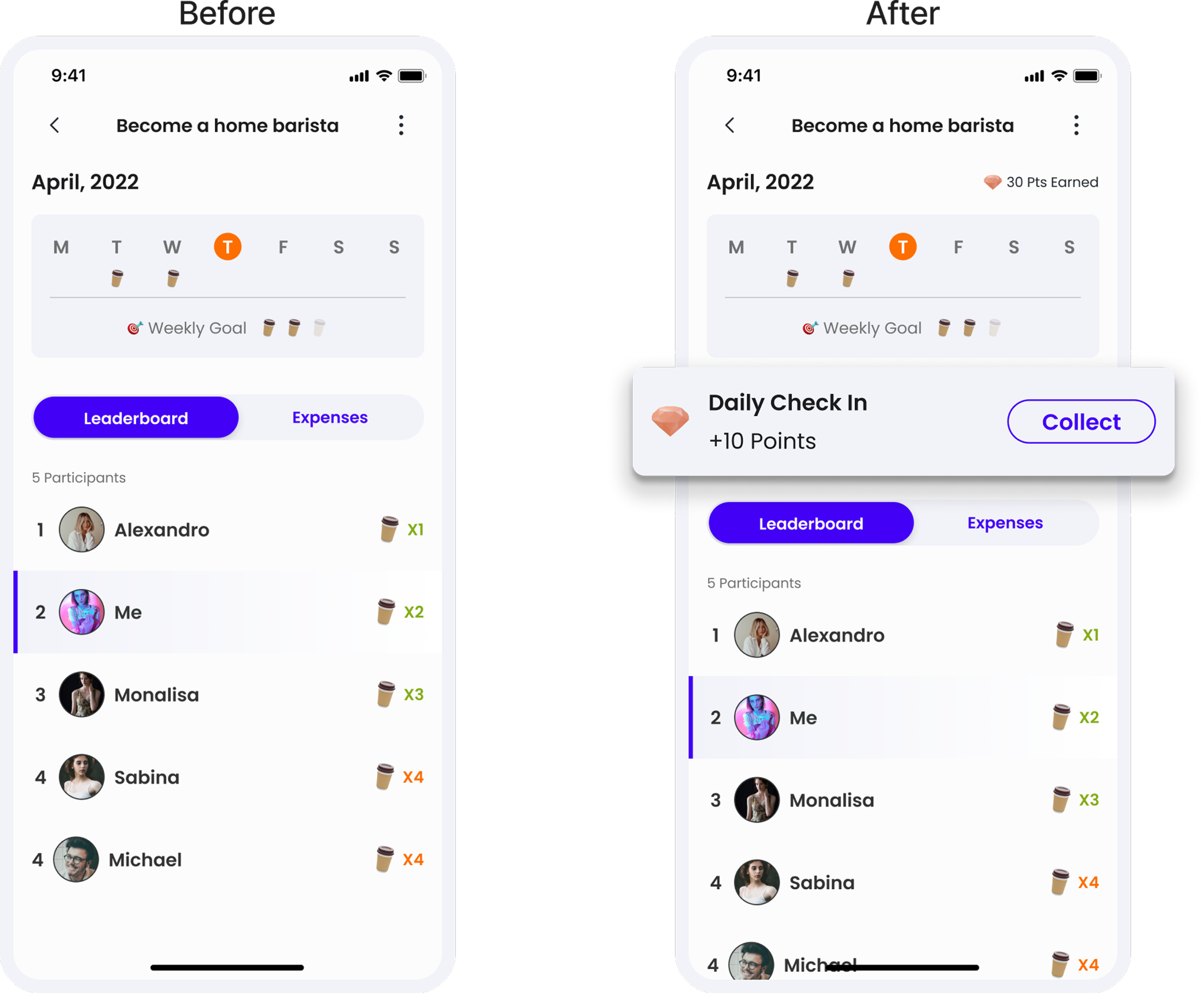
Check-in Mechanism
A daily check-in feature rewarded users for consistency, offering instant gratification and boosting DAU.
Testing Roadblock
User struggles with adapting to reward system overhaul, causing challenges to testing accuracy.
In our usability testing of the first version of the design, we discovered that existing users struggled to adapt to the complete overhaul of the reward system. This resulted in a learning curve that hindered users' ability to fully engage with the new system and impacted overall usability, preventing us from accurately measuring the true feasibility of the changes.
Quick Change
Small-scale adjustments to existing reward system
To minimize the learning curve associated with a full transition to a points system, I opted to modify only the accumulation mechanism within the existing currency system. This approach allows users to adapt more quickly to the new changes while maintaining familiarity with the core system.
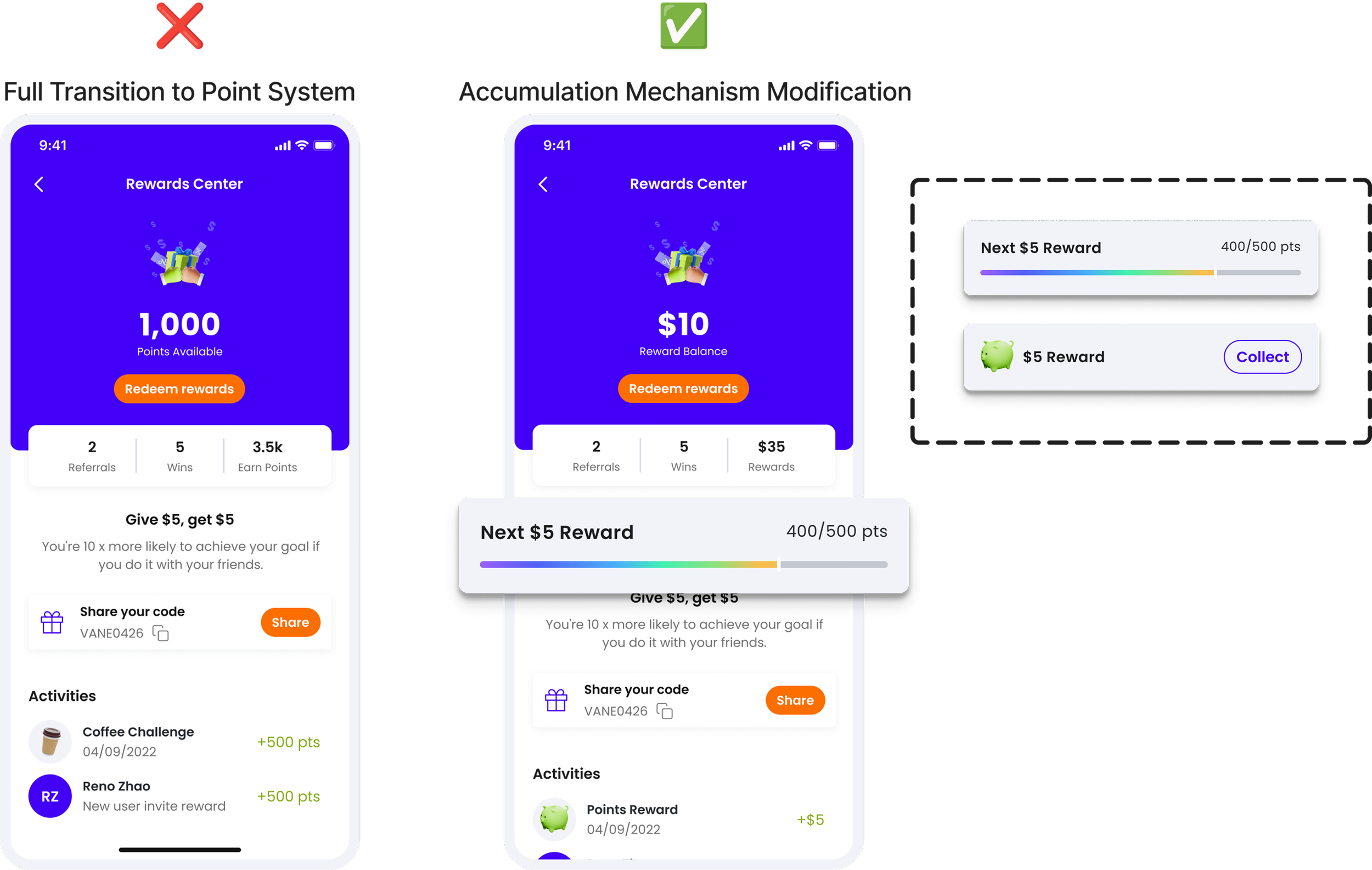
Partial Transition to Points System
The partial transition to a points system minimized the learning curve, allowing users to adapt smoothly. This balance of innovation and familiarity ensured a seamless experience while testing the new system.
Beta Launch
Beta launch fell short despite positive testing, revealing an overemphasis on external rewards.
Despite positive feedback during prototype testing, the beta launch did not yield significant improvement. This led us to a critical realization: We had placed too much emphasis on external rewards and overlooked the intrinsic motivation of financial improvement and social engagement.
+1.2% DAU Growth
❌ Statistically insignificant increase
+2% Week 2 Re-engagement
❌ No meaningful improvement
📉 Key findings from user interviews:
Our over-reliance on external incentives led to diminished results.
-
While users appreciated the new point system, it did not fundamentally address the frustration of losing repeatedly.
-
The challenge still felt more about "winning" than actually improving spending habits.
-
Users felt isolated in the experience—there was no meaningful way to interact with friends during the challenge.
Pivot
Inspired by an app store review, I shifted the design direction to prioritize helping users quickly realize the value of their participation.
At this stage, our team had hit a roadblock. Despite multiple iterations, we struggled to find a breakthrough—every design tweak felt like a band-aid fix rather than a true solution. Just when we were running out of ideas, one unexpected App Store review sparked a new direction:
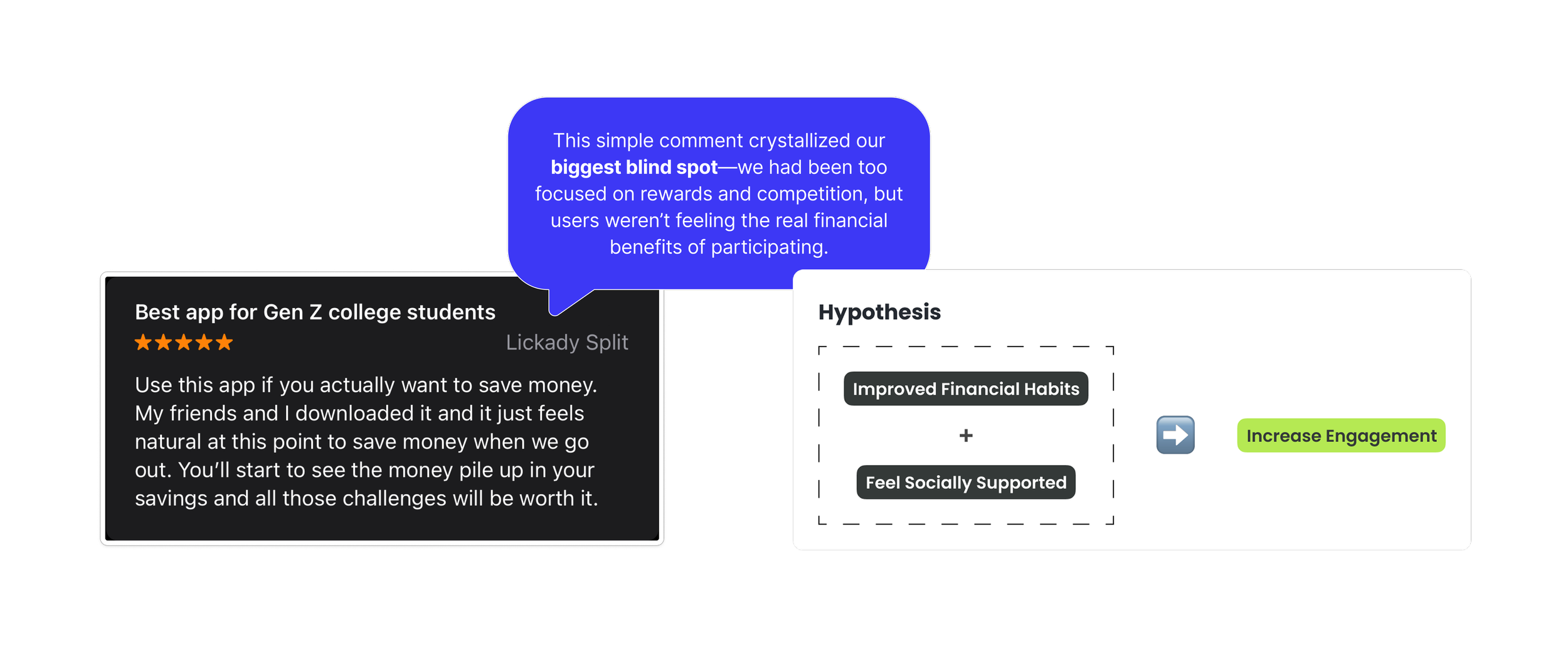
Motivations to join a saving challenge:
We thought was rewards
💰
Turned out they might be personal improvement & social validation
📈
👯♂️
Iteration
Design for emotional engagement - making progress feel real
To shift the focus from pure competition to personal financial growth, we introduced key emotional touchpoints throughout the challenge journey:
Change 1
Celebrate small wins
We introduced milestone checkpoints that highlighted users’ progress in real time, to reinforce a sense of accomplishment.
Check-in Streak
Implemented a check-in streak popup to celebrate small wins that every user can achieve, helping to build confidence and reinforce engagement.
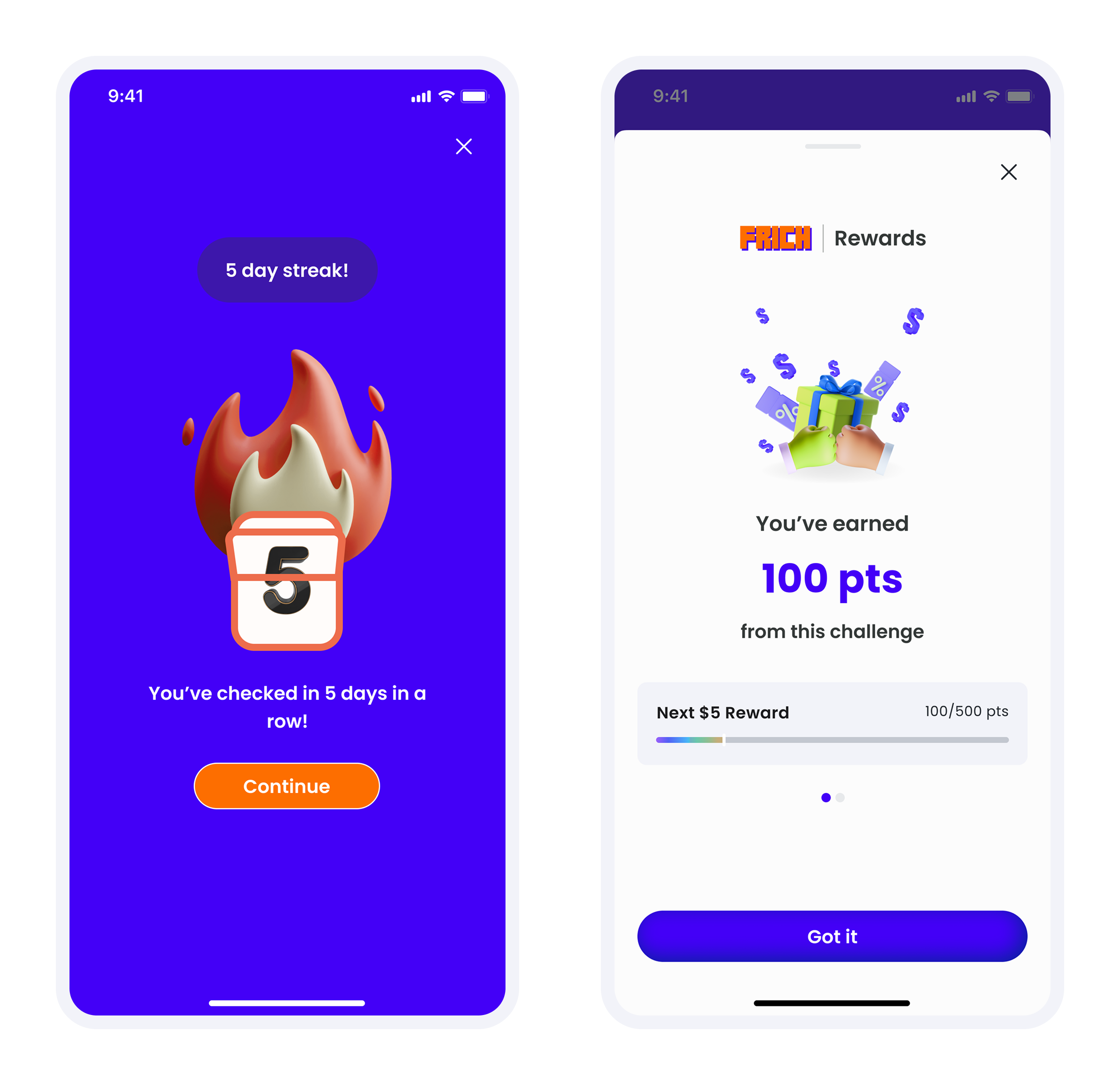
Small Win is Worth Celebrating
Even for small rewards, we celebrated with users to build their confidence and motivate them to continue the challenge.
Change 2
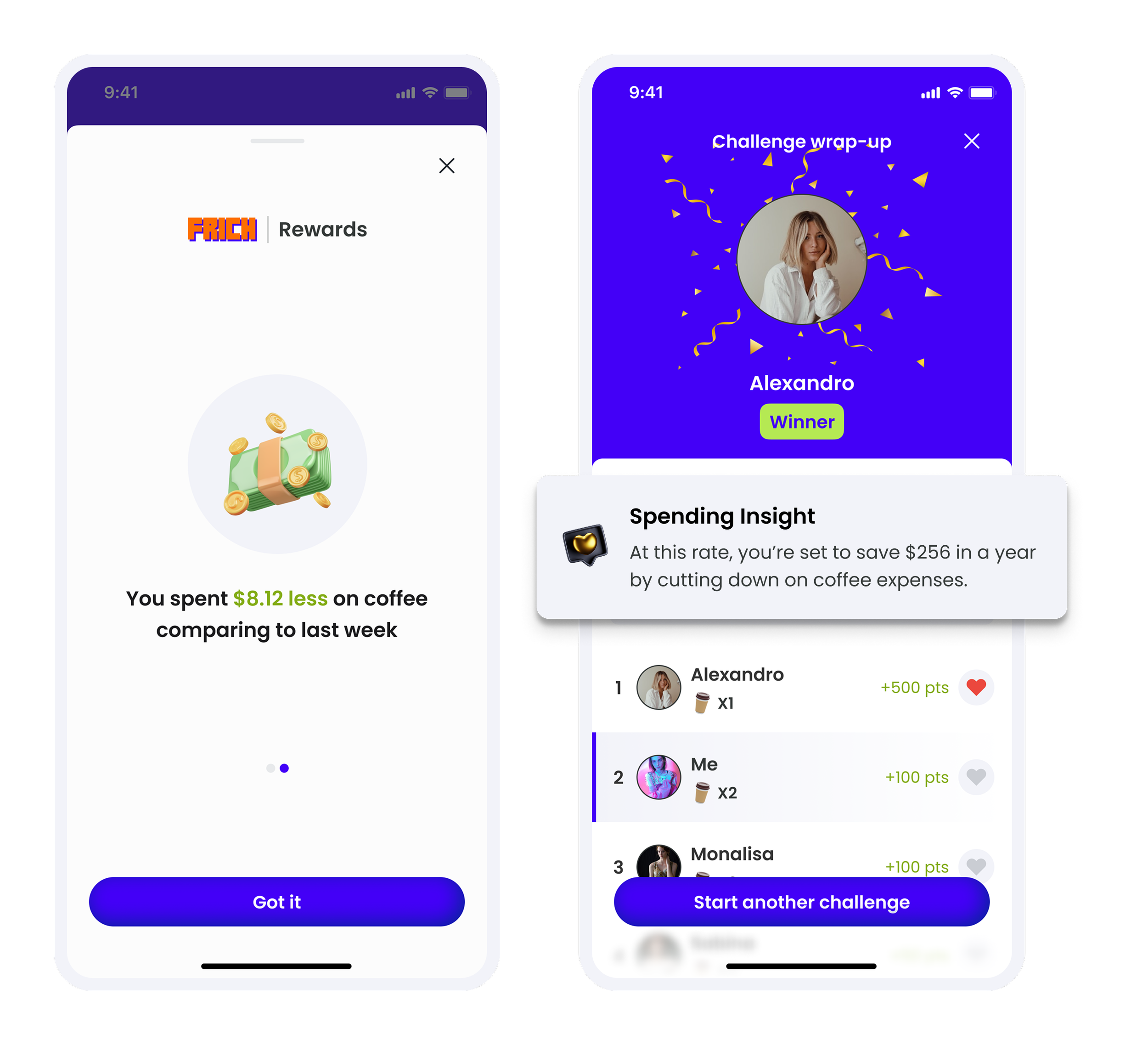
Personalized spending insights
We made financial changes tangible by surfacing key behavioral shifts in an engaging and visual way, creating emotional resonance with spending habits.
Personal Saving Benchmark
We showcased users' savings progress, allowing them to benchmark against their past performance and build a sense of achievement.
Social-Based Engagement
We added a "like" feature on the challenge results page to encourage users to support each other, fostering social-based engagement.
Change 3
Encourage social recognition
Created peer validation mechanics to strengthen user motivation. The presence of continuous social touchpoints strengthened commitment and accountability.
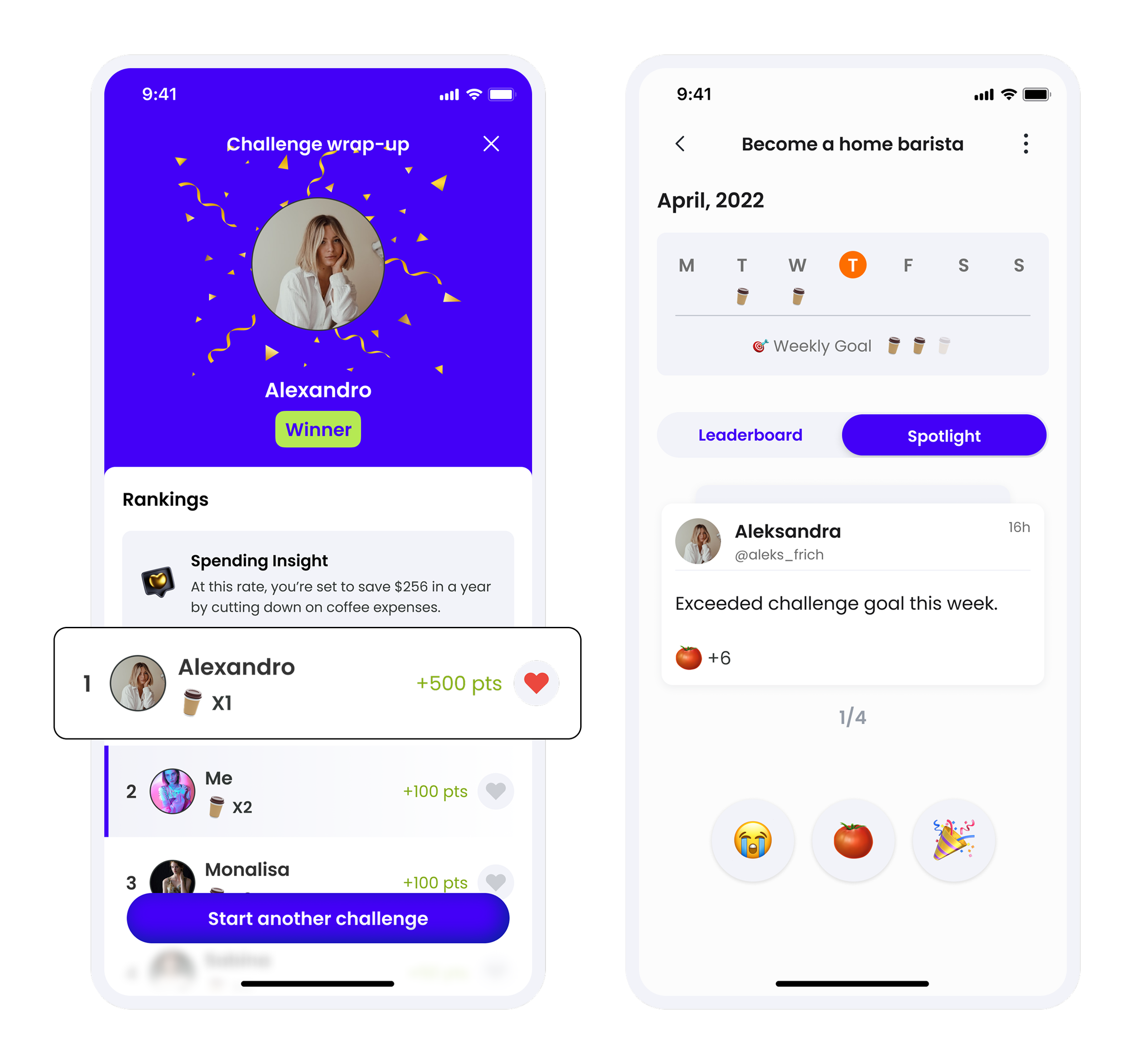
In-Challenge Insight
During the challenge, we introduced multiple savings forecasts to project future savings, encouraging users to stay committed and maintain financial discipline.
Interactive Social Feeds
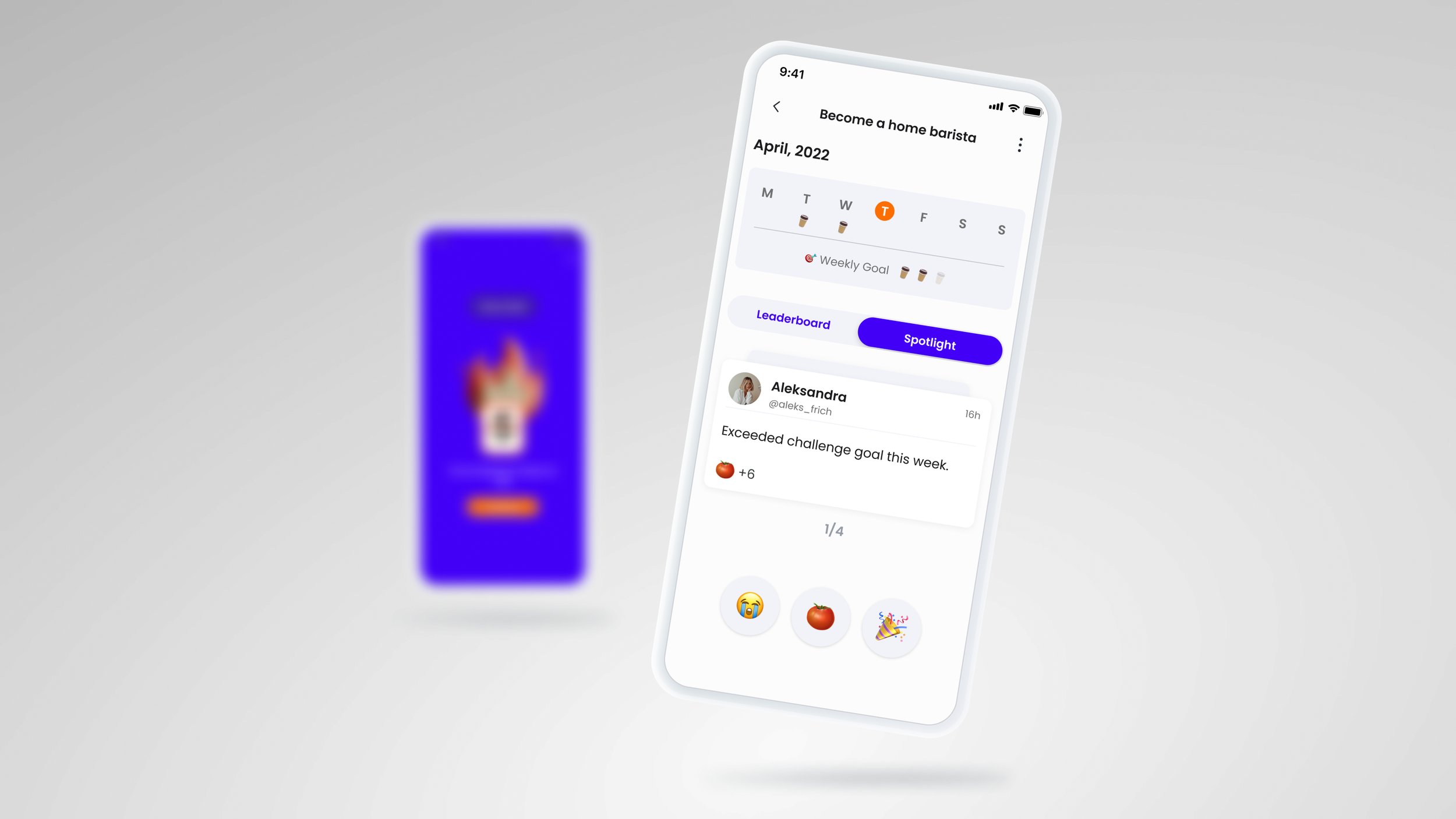
We transformed users' challenge milestones and real-time progress into interactive social feeds, using reactions to make the experience more engaging and further drive daily activity.
Design Validation
A streamlined and efficient flow to achieve the design objectives.
Now let’s connect all the dots and look at what the updated experience looks like:
Flow 1
Daily Engagement Boost
Create a positive feedback loop that drives long-term user engagement.
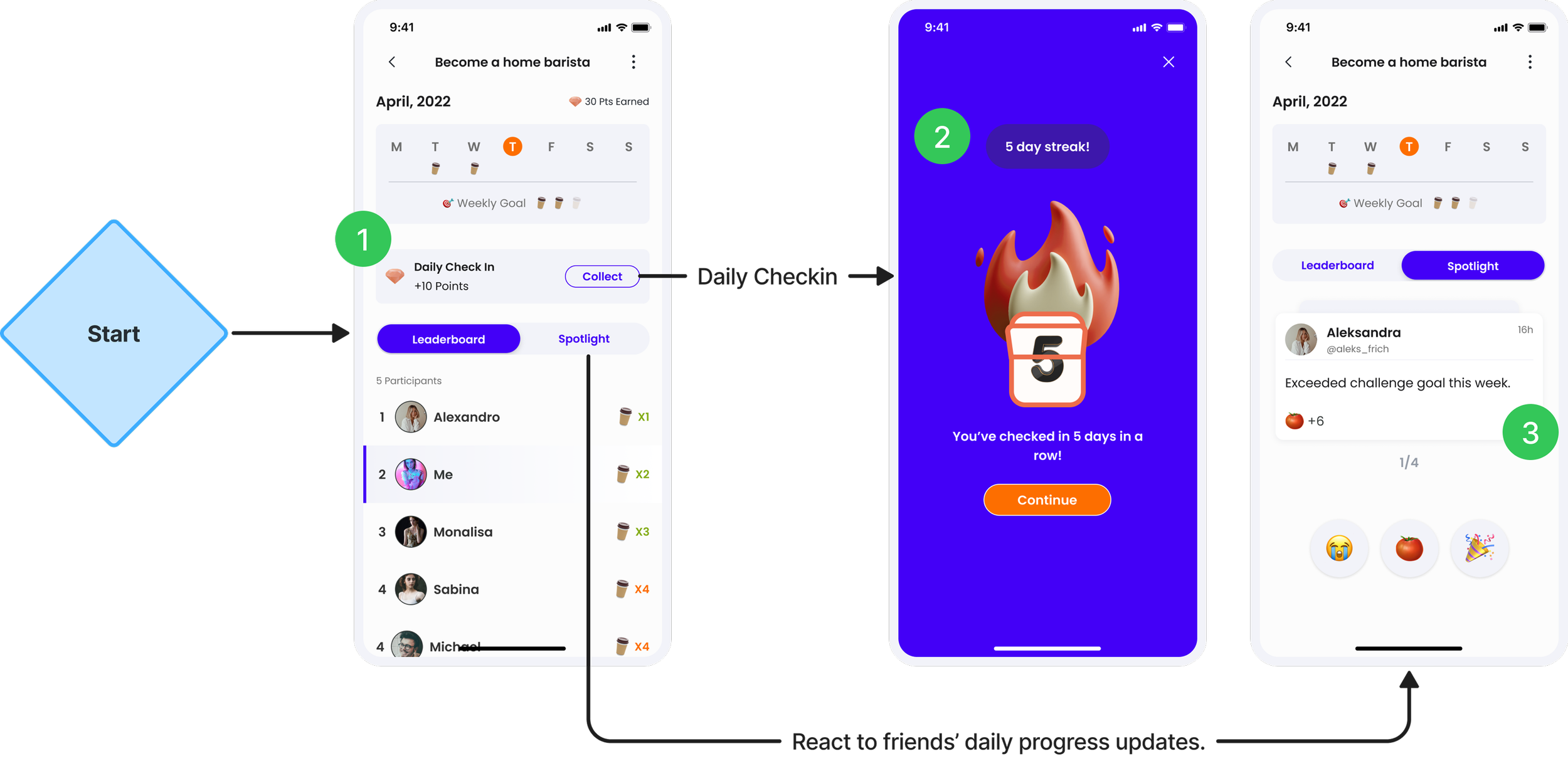
1. Reward Daily Activity
Encourage and reward users for their consistent daily activity, fostering habit formation and increasing engagement.
2. Reinforce Consistent Check-ins
Strengthens user behavior habits, motivating them to maintain continuous check-ins, avoid interruptions, and enhance long-term engagement.
3. Maintain Engagement and Fun
This not only enhances the sense of community but also provides inspiration, making the challenge more enjoyable and satisfying through social interaction
Flow 2
User Retention Enhancement
Multiple motivational touchpoints related to social interaction and behavior change have been added at the end of the challenge to help keep users engaged.
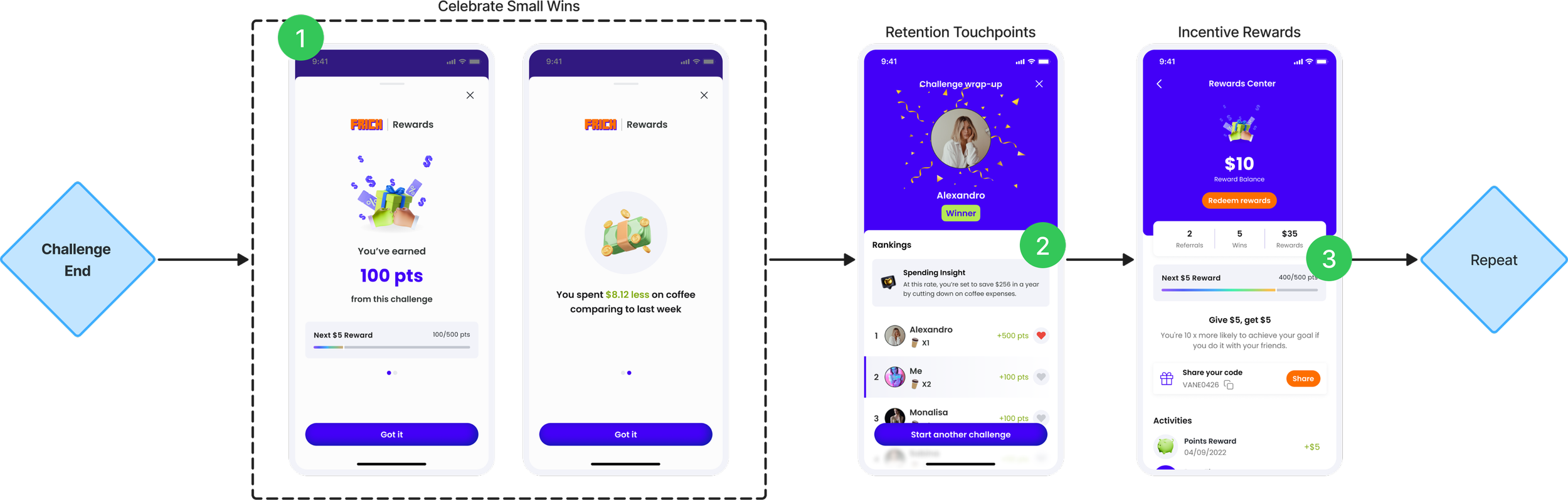
1. Celebrate Small Wins
We celebrate the achievements users gain after completing a challenge, helping to reduce feelings of failure
2. Encourage Next Challenge
By enabling mutual likes and providing savings forecast tips, we encourage users to participate in the next round of challenges."
3. Stay Committed
By showcasing the progress bar for the next reward, we further enhance user motivation to stay committed and continue engaging.
Final Results
Intrinsic motivation and social recognition drove meaningful engagement gains!
Following the release, we saw tangible improvements. Though incremental, these results confirmed that intrinsic motivation—seeing real financial progress—was a stronger retention driver than external rewards alone.
+33%
+25%
DAU Growth
DAU Increase: 18% -> 24%
2nd Week Re-Engagement Rate Increse
Re-Engagement Rate: 32% -> 40%
Takeaways
Designing for engagement and retention
This experience reinforced the importance of data-driven design, behavioral psychology, and iterative problem-solving— a mindset I continue to apply in my work.
Key Learnings
-
The initial failure was due to an overemphasis on extrinsic rewards.
True engagement comes from helping users recognize their own progress. -
Small nudges that highlight spending changes helped create habit-forming behaviors.
Celebrating milestones reinforced positive reinforcement loops. -
Instead of rebuilding the entire feature, gradual iterations (insight panels + modals) allowed for faster learning & data validation.
This ensured alignment with business goals, user needs, and development constraints.